
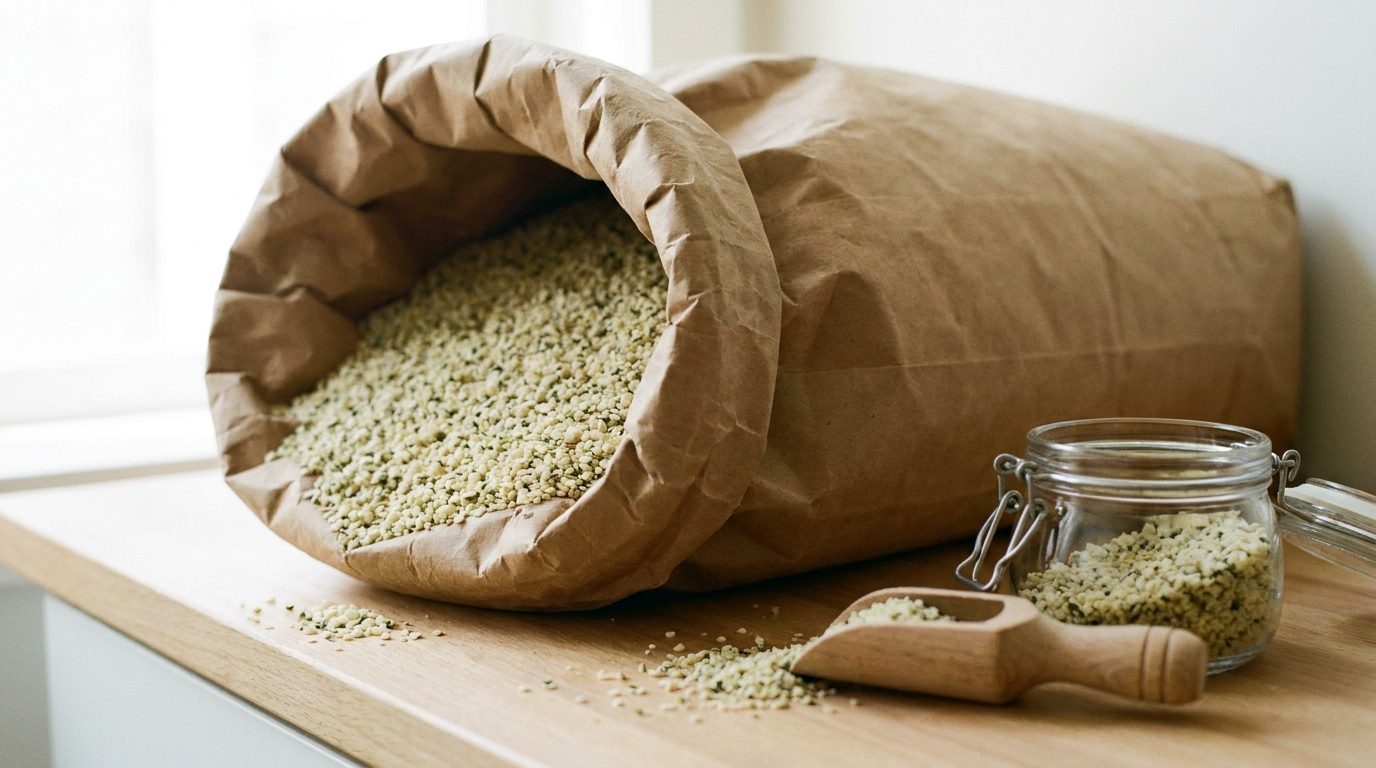
A one-kilogram bag of hemp hearts almost always carries a lower price per 100 g than a small pouch. Whether that actually saves you money depends on how quickly your household eats, and on where the leftovers live.
Why unit price is the wrong number on its own
The per-100 g figure on a shelf tag is the fastest way to compare two packages of anything that keeps well. Hemp hearts do not keep especially well. They are close to half fat by weight, and that fat is dominated by polyunsaturated fatty acids — the family that oxidizes fastest when exposed to warmth, light and air. A bag that turns bitter in its fourth month is not cheap at any unit price, because the last third of it goes in the compost.
The number that matters is the price per kilogram you actually eat, in good condition. That turns bulk buying into a storage question first and a shopping question second. If you have freezer space and a daily habit, big bags are a genuine saving. If the bag is going to sit open on a warm counter next to the toaster, the small pouch is the cheaper purchase.
How fast does your household really go through them?
Most people overestimate this badly. A generous spoonful over yogurt or into a smoothie is roughly 30 g, which is about two to three tablespoons. Do the arithmetic before you commit rather than after.
| Your habit | Roughly per week | How long 1 kg lasts |
|---|---|---|
| A light sprinkle most mornings | about 100 g | around 10 weeks |
| One full serving daily | about 210 g | around 5 weeks |
| Two people, daily | about 420 g | a little over 2 weeks |
| Occasional baking and smoothies | about 60 g | four months or more |
Anything past about two months of open storage at room temperature is where the risk starts to climb. If a pack size puts you well beyond that window, plan to freeze the surplus from day one, or drop down a size.
Bulk bins versus sealed bags
Gravity-fed bulk bins are usually the cheapest hemp hearts in the store, and also the least predictable. The seed sits under display lighting, gets topped up rather than rotated, and is scooped by hundreds of hands. You cannot see a packing date or a lot code, and you cannot tell whether the batch arrived last week or last season.
Signs a bin is worth using: obvious turnover, a store that dates its bins, product that looks pale creamy green rather than dull grey, and no smell of stale oil when you open the flap. Signs to walk away: oily residue inside the chute, clumping, or a bin sitting in a sunny window. Sealed bags cost more per gram, but you are buying information — a date, a lot number, and often a packaging barrier that makes the stated shelf life mean something.
What to check before you commit to a big bag
- The date, and which kind it is. A best-before date is only as good as the storage that preceded it. A packing or pressing date tells you more, when it is there.
- Resealability. Large bags often have no zipper at all. Budget for a jar or a clip.
- Where it was sitting. A warm end-cap display is not the same as a cooler shelf, whatever the label promises.
- Taste, if you can. Fresh hemp hearts are mildly nutty and faintly sweet. Bitterness, a paint-like note or a sharp finish means oxidation has started.
- The return policy on food. Some retailers will take back rancid product. Worth asking before you buy several kilograms.
Splitting, freezing and the sensible middle ground
The most reliable way to make bulk pay is to decide at the moment of purchase that the bag gets broken down immediately. Portion it into jars or freezer bags in amounts you will finish in three or four weeks, press the air out, and freeze everything except the jar in use. Hemp hearts do not freeze into a solid block; they stay loose and spoonable straight from the freezer, so there is no thawing step and no repeated condensation cycle as long as the working jar stays separate.
Splitting a large bag with another household works for the same reason, and it solves the problem bulk buying creates: nobody is left holding four months of open inventory. If you are still working out which hemp products you will actually use often enough to buy deep, start small and read up first — there is a wider set of guides in our articles library.
When the small bag is genuinely the better buy
Buy small when you are trying an unfamiliar brand, when the product is hemp protein powder or hemp flour rather than hearts, when you have no freezer space, or when the only bulk option is a bin you cannot assess. Buy small in summer if your kitchen runs hot and your only storage is the cupboard above the stove. Powders and flours deserve particular caution, because they are used in smaller quantities, sit longer, and have far more surface area exposed to air than whole hearts do.
Set yourself one rule and the decision becomes easy: never buy more hemp than you can keep cold and finish within about three months. Work out your weekly use in grams, multiply by twelve, and buy the largest pack that lands under that number — then split and freeze it the day it comes home. Handled that way, the big bag is a real saving. Handled any other way, it is just a slower and more expensive route to the compost.