
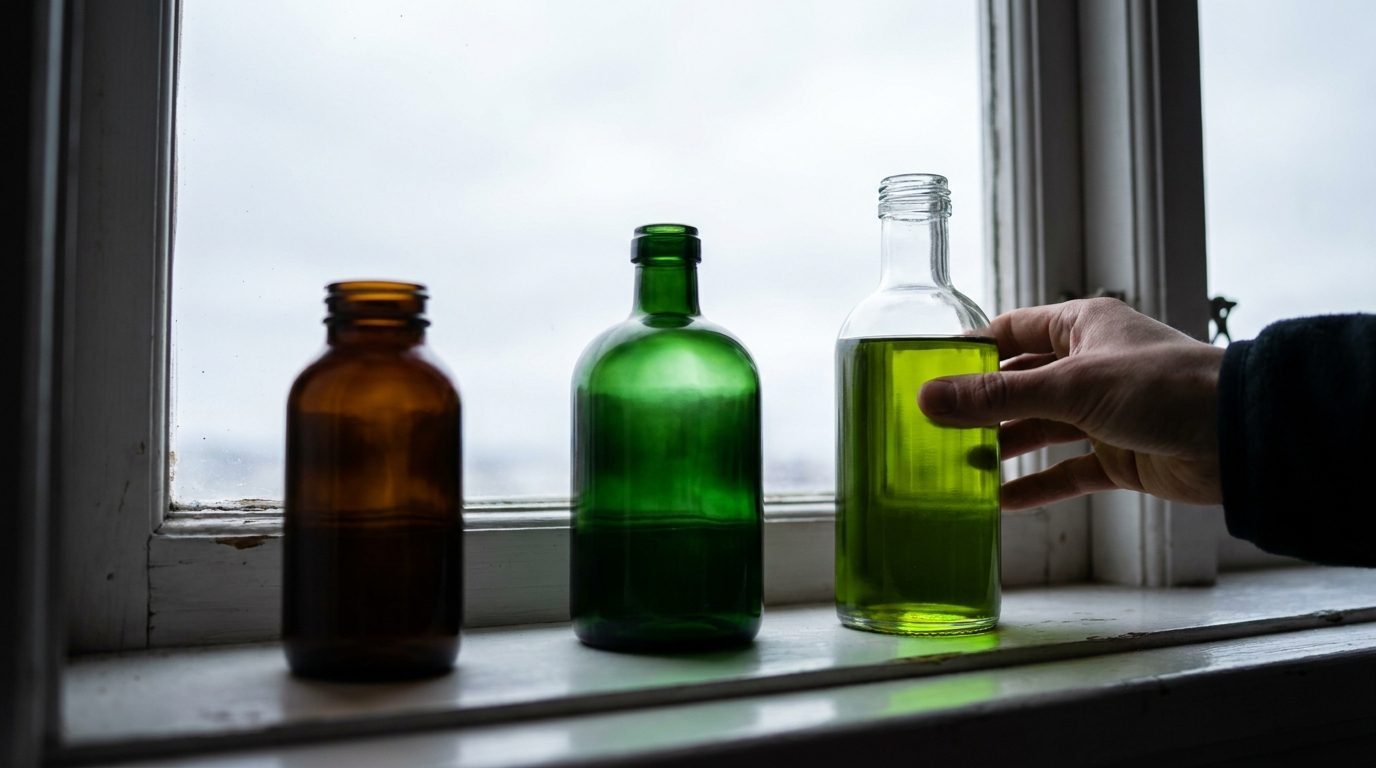
Hemp seed oil is one of the few products in the cooking aisle where the packaging tells you more than the front label does. Dark glass, a cold shelf and a recent date beat any adjective on the bottle.
Why hemp seed oil is packaged differently from olive oil
Hemp seed oil is dominated by polyunsaturated fatty acids, including a substantial share of alpha-linolenic acid, the plant omega-3. That composition is the reason people buy it, and it is also the reason it is fragile. Polyunsaturated fats react with oxygen, and heat and light accelerate the reaction. Olive oil, which is mostly monounsaturated, tolerates a clear bottle on a warm shelf far better.
So the packaging is a signal about how seriously the producer takes their own product. Dark glass or an opaque bottle, a modest bottle size, and refrigerated display all suggest someone who understands what they are selling. A large clear plastic bottle sitting under aisle lighting suggests the opposite, no matter how good the copy on the label is.
What the colour actually tells you
Unrefined, cold-pressed hemp seed oil is usually some shade of green, from grassy to deep olive, because of chlorophyll and other pigments carried over from the seed coat. The exact shade varies with variety, growing conditions, how thoroughly the seed was cleaned, and how hard the press worked. Green is therefore not a quality grade, and a darker green oil is not automatically a better one.
Colour is most useful as a comparison, not an absolute. If you know a product and this bottle looks noticeably duller, browner or more washed out than usual, that is worth noticing. A little fine sediment at the bottom of an unfiltered oil is normal. Cloudiness that will not clear at room temperature, or a bottle that looks separated, is not.
Is “cold-pressed” a claim worth paying for?
Broadly, yes, but understand what it means. Cold-pressing describes mechanical expeller pressing without applied heat. Friction inside the press still generates some warmth, so “cold” is relative rather than literal. What the phrase usefully rules out is solvent extraction and high-temperature processing, both of which change the flavour and strip out minor components.
The claim is most meaningful when it appears alongside other specifics: unrefined, a named pressing or best-before date, and a producer willing to say where the seed came from. On its own, next to no other information, it is just a word.
Refined hemp oil, and the CBD confusion
Refined and deodorized hemp oil is paler, close to neutral in flavour, and considerably more stable. It exists mainly for food manufacturing and cosmetics, where a strong grassy note and a short shelf life would be liabilities. It is a legitimate product, but it is not what most people are shopping for when they buy a bottle for salad dressing.
The more common confusion is between hemp seed oil and CBD oil. They are different products from different parts of the plant. Seed oil is pressed from the seed and contains essentially no cannabinoids. CBD is extracted from flower and leaf material, and in Canada it cannot legally be added to food. If a small dropper bottle labelled “hemp oil” is priced like a supplement, you are looking at a different category entirely — check the ingredient list and the format before assuming the two are interchangeable.
Size, dates and where the bottle has been
Buy the size you will finish within roughly six to eight weeks of opening, not the size with the best unit price. Once the seal is broken, the clock speeds up. A 250 mL bottle you use twice a week is a better purchase than a litre you nurse through the winter.
Look for a pressing date if the producer provides one; it is more informative than a best-before date that assumes ideal storage. If the store keeps hemp oil in a cooler, that is a good sign about the store as well as the product. If it is on an ambient shelf, ask how long it has been there. At home, the bottle belongs in the fridge with the cap tight, and the oil belongs in cold or barely warm applications — dressings, drizzles, dips, blended into smoothies — rather than in a hot pan. For more on how hemp products differ from one another, browse our articles.
The practical shopping test takes about fifteen seconds. Pick up the bottle: is it dark, is it small enough to finish, is there a real date on it, and was it stored cold? If three of those four are yes, buy it and put it straight into your fridge when you get home. If two or more are no, leave it — a cheaper bottle of oxidized oil is not a bargain, and the bitter, crayon-like taste of hemp oil past its prime will do more to put you off hemp than any price ever could.